I just finished reading a fabulous book, Where the Jungle Meets the Sea, by C.L. White. In the first chapter, she boldly addresses an issue that I wrestled with for sixteen years in Costa Rica: being approached for money because of the assumption that a pale, freckled-face foreigner from the United States would have lots of it.
I met White circa 2009 at a language school that we both worked at in Heredia, Costa Rica, and we became friends. Several years later, she returned to her home state of Kentucky, only to realize that she would much rather live in Costa Rica. So she returned to paradise, and her recent book, Where the Jungle Meets the Sea (available on Amazon) documents her odyssey.
During her trip to the Caribbean coast where she planned to settle permanently, a "shirtless and sockless" youth of Jamaican descent approached her for money to buy a Coke at the bus stop (White 6). She turned him down and suggested he drink water, like she was doing.
She encountered him again on the bus where he repeated his plea for money, this time for food. She was torn between a desire to help a fellow human being who said he had recently gotten out of prison and was headed home to family - a story that checked out as the Caribbean coast of Costa Rica has a large population of the African diaspora - and a fear that she was potentially enabling an addict.
This was the exact quandary that I faced regularly in Costa Rica. Do I believe their story and give them some money? Or do I turn away, believing that they're probably manipulating me for money to buy drugs?
White and I are both from North America, and we both lived full-time in Costa Rica but were commonly mistaken for tourists. Our culture taught us to be cynical of beggars. Just like White in this scenario, I would have questioned, "Why couldn't he get a job somewhere?" (White 7). White and I were both used to (and weary of) being targeted as rich foreigners, despite our economic limitations.
But a funny thing happened in my first year living in Costa Rica in 2007: on bus rides everywhere in the country, I saw Costa Ricans generously giving coins to beggars who would stand up and voice their woes. Costa Ricans didn't seem to have the same dilemma as I did. I worried that they would use my hard-earned money to feed addictions.
It got me wondering, through years of cultural observation, why does it matter so much to me how they will use the money? Doesn't it matter more what my response to another human being is? Am I willing to help, or am I more concerned about controlling where my money ends up?
Having been raised on strong Biblical doses, I couldn't help but notice that these Costa Ricans were a lot like Jesus, giving freely when they could without stressing about how the recipient used their generosity. Jesus didn't forgive prostitutes because they promised to stop selling their bodies. He forgave them because he could. Because he wanted to show love.
I don't write about this to say that I have now mastered a solution to this predicament. There really is no neat ending to this blog. But throughout my time in Costa Rica, I became more generous as I simultaneously became more aware of my privilege. In reading White's book, I could see that living in the tropics had a similar affect on her.
My definition of wealth was very different from the average Costa Rican. The fact that I could choose to live in a foreign country and start a business there, albeit on very little money, was an example of that privilege. Costa Ricans with less in the bank than me were far more generous to the needy. I could learn something from them.
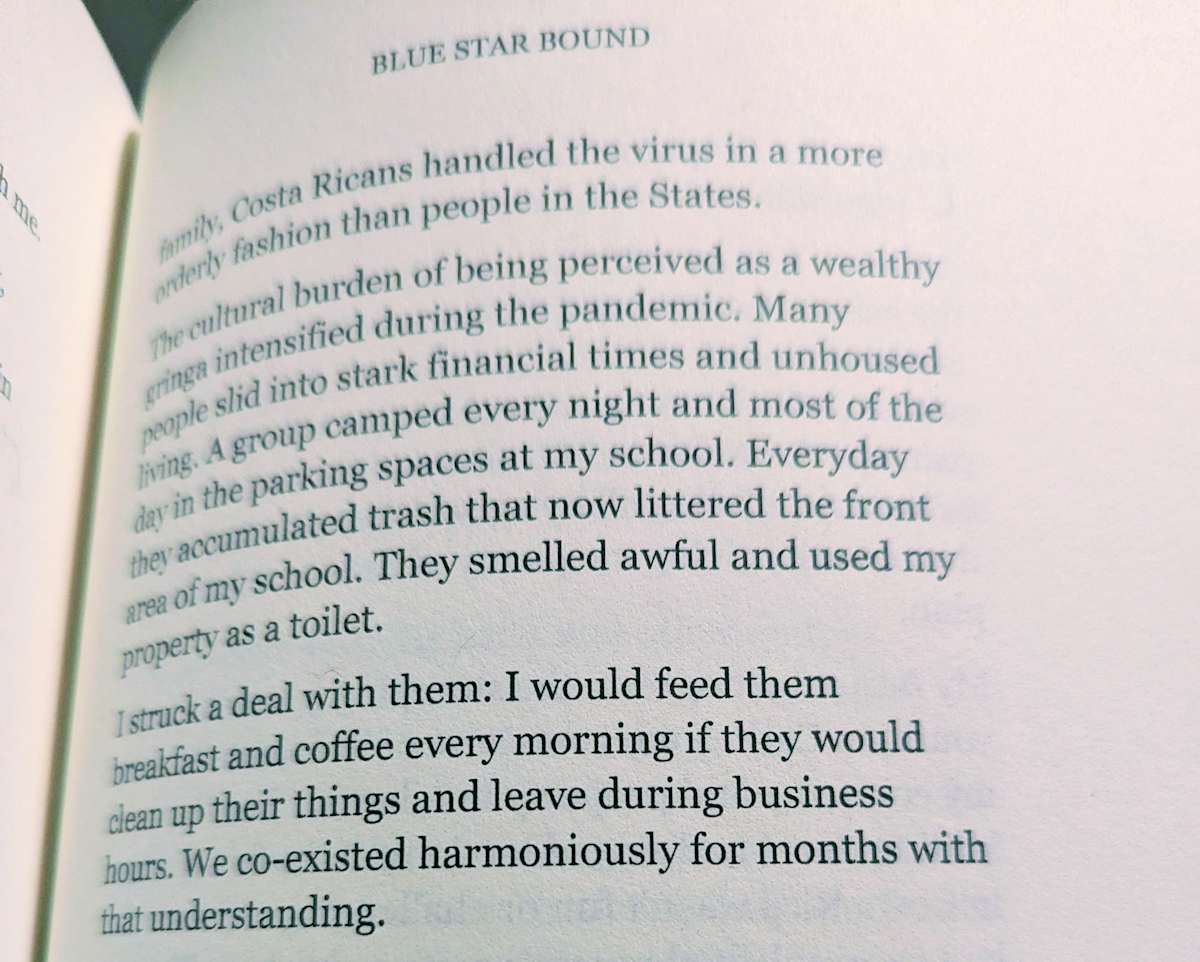
Fast-forward to 2020, the pandemic ripped through the globe, causing increased desperation in my small corner of the world - Liberia, Costa Rica. In my memoir, Blue Star Bound, I explain, "The cultural burden of being perceived as a wealthy gringa intensified during the pandemic" (287).
A regular group of homeless people made my school's property their home each night, littering it with their garbage and causing an unsavory smell of urine and excrement. This was bad for business, but I knew they had no where to go. There were no homeless shelters or any government assistance that I knew of.
So I struck a deal with them: I fed them breakfast and let them sleep there in exchange for them cleaning up their things and leaving the premises during business hours. I often gave them money for whatever they said they needed. The old Bethany would never have considered helping them without knowing with certainty how the money would be spent.
Now that I live back in the States, I no longer carry such an obvious cultural burden. I don't stand out, and no one thinks that I am filthy rich because I am just an average citizen in a average town in Northern California. Honestly, it's nice to not be approached daily for money. But there are other cultural burdens on my heart.
Now my focus is centered on the common good in the United States. How can I help my compatriots who are less fortunate? Which politicians can I vote for who will fight to increase the quality of life for all, not just those with fat bank accounts? How can I show compassion to my high school students, trudging through their complex worlds of change and confusion? I want to be more generous with love and tolerance towards my neighbors, without expectation of reciprocation.
Through reading White's book of adapting to another culture and coming to terms with its imperfections, I reflected on my current core values. My belief system today is largely due to spending so many years as an immigrant in Costa Rica. Needless to say, I highly recommend White's book as a way to spark inward analysis and growth.